September 2, 2026
<-- Back To All Blog Posts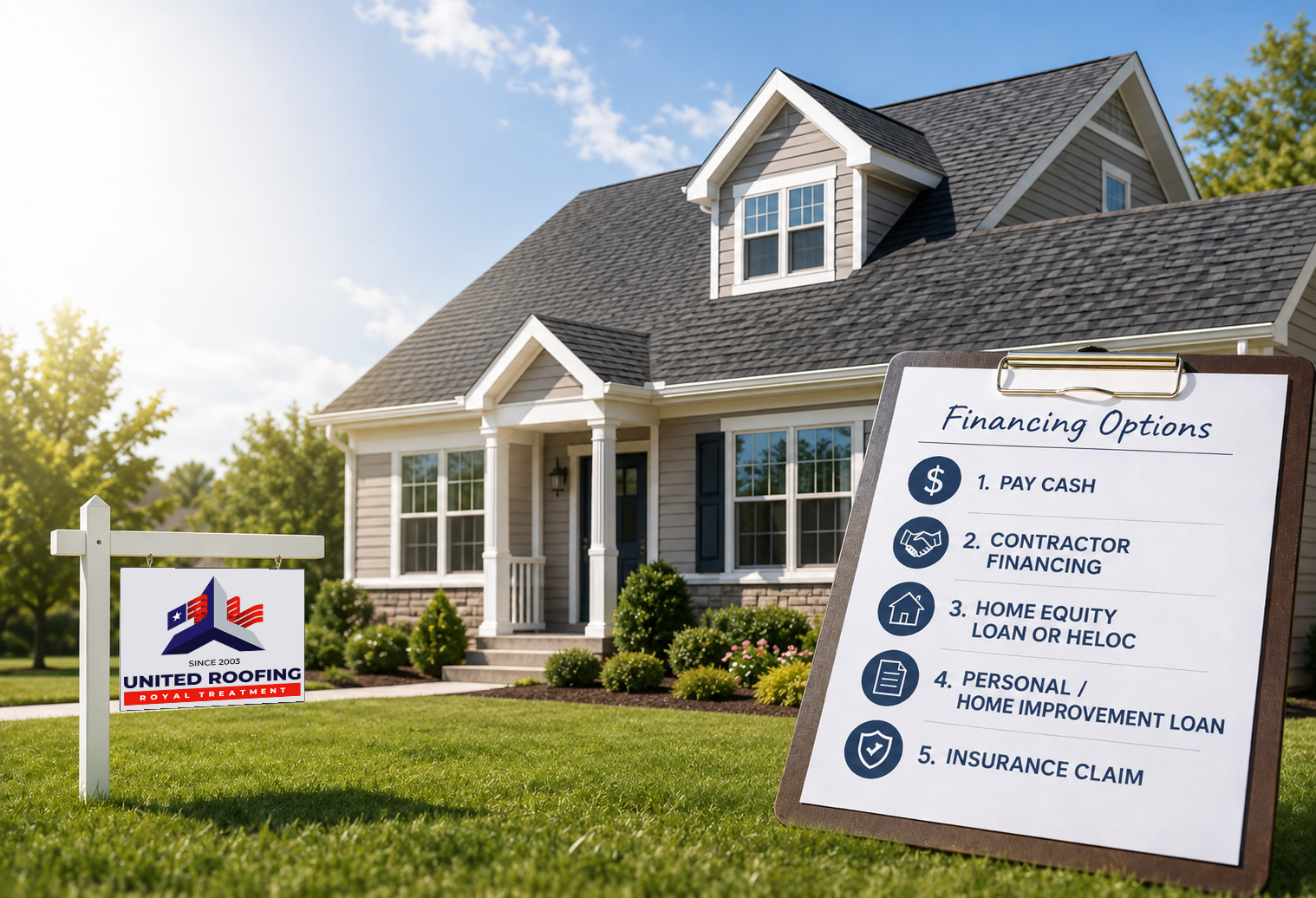
A roof replacement is one of the largest home-improvement expenses most homeowners will face. Even when you know a new roof is necessary, figuring out how to pay for a new roof can be nearly as important as deciding which roofing company to hire. Fortunately, homeowners have several ways to pay for roof replacement. Some people pay from savings, while others prefer monthly payments through contractor financing, a home equity loan, or a personal loan. In certain situations, homeowners insurance may cover part of the cost when the roof has been damaged by a covered event.
The right option depends largely on why the roof needs to be replaced, how quickly the work needs to be completed, your household's financial reality, and how you prefer to manage the expense. Below are five of the most common ways homeowners pay for a new roof.
Paying cash is the most straightforward way to purchase a new roof. If you have sufficient savings available, paying for the project without financing means there are no loan applications, monthly payments, or financing charges.
Many homeowners pay for the entire project from savings, while others combine cash with another payment method. For example, a homeowner might make a substantial down payment from savings and finance the remaining balance. Our Roofing Experts will work with you to find any discounts and incentives we offer to minimize the shock of a sudden out-of-pocket expense like replacing your roof.
Of course, no one wants a 5-figure expenditure to suddenly appear... but they often do. That's why United Roofing will match any "apples-to-apple" roofing quote you present signed, and in writing from another licensed, bonded, and insured roofing company in our Coastal Carolina and Upstate service areas. We want you to have to pay as little out of pocket as you possibly can while making sure you have the best roof your money can buy.
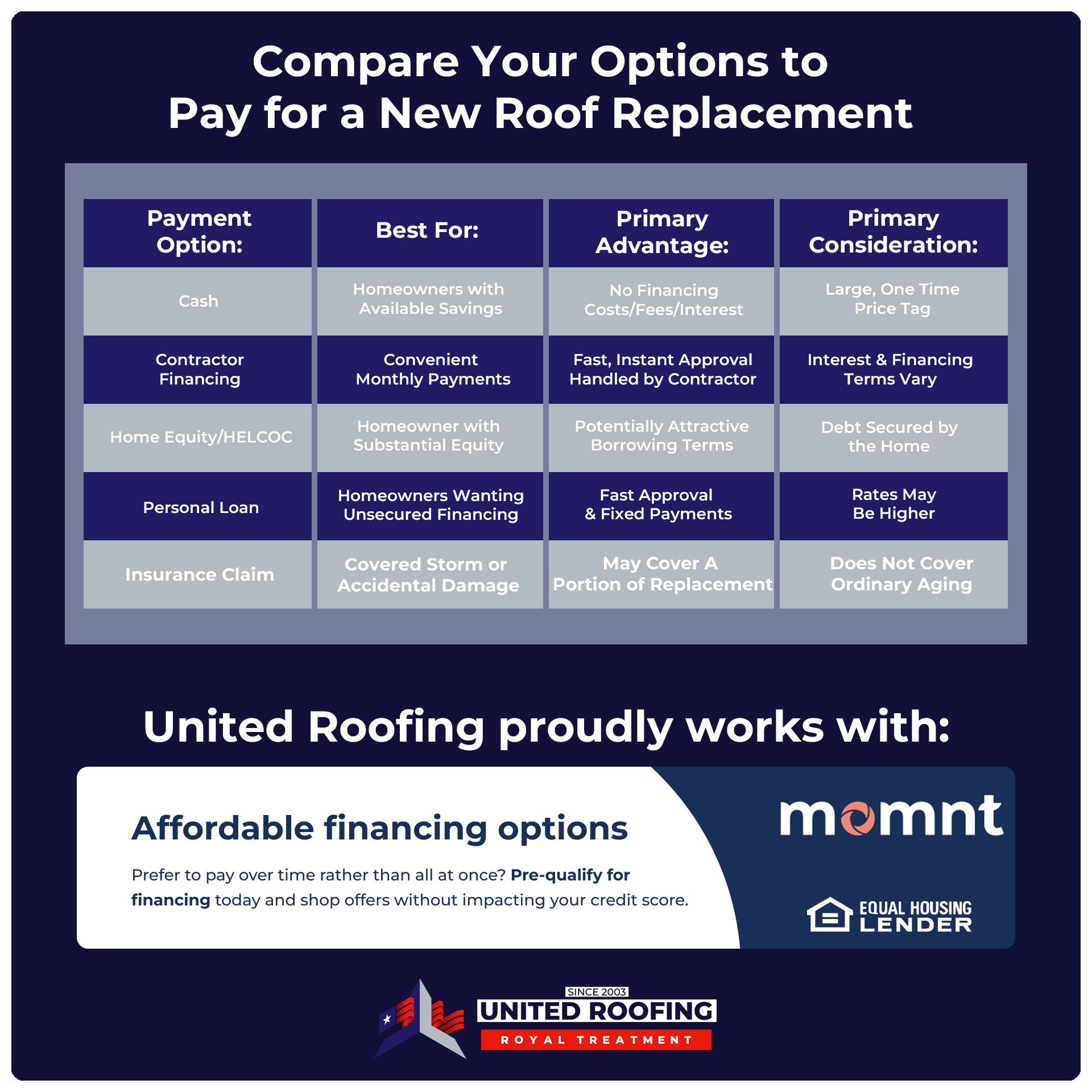
Best to consider if you are: Homeowners with sufficient savings who want to avoid interest rates and monthly payments.
Typical repayment structure: No repayment. Your roof is paid directly from available funds.
Contractor financing has become one of the most convenient ways to pay for a roof replacement because financing can often be arranged at the same time as the roofing project. Instead of bouncing between a lending institution,approved manufacturers, and roofing contractor, you can have a single point of contact when it comes to... well, all of it. Rather than requiring homeowners to independently shop for a bank loan (and their manufacturer/materials limitations), roofing contractors may work with third-party financing companies that specialize in home-improvement lending.
United Roofing, for example, works with Momnt. They help bring our homeowner's simple, fast, and affordable financing options. Convenient monthly payments allow you to pay over time for home improvement projects. Simply answer a few questions to see if you're pre-qualified. Once pre-qualified, you’re able to view promotional financing offers with no impact on your credit score. Qualified borrowers can access up to $75,000, and there are no early payment penalties.
There is no hit to your credit to see if you qualify (soft credit pull) and you can sit back and relax as your roof, financing arrangements, and schedule installation are all handled by the same Roofing Expert.
Best to consider if you are: Homeowner who need a roof now but prefer a predictable monthly payment rather than paying the entire cost upfront.
Typical repayment structure: Fixed monthly payments over an agreed-upon financing term.
Homeowners who have built substantial equity in their property may be able to use that equity to finance a roof replacement.
A home equity loan generally provides a lump-sum amount that is repaid through scheduled monthly payments. Because the loan is secured by the home, interest rates may be more favorable than those available through unsecured borrowing.
A Home Equity Line of Credit, or HELOC, works somewhat differently. Instead of receiving one lump sum, the homeowner receives access to a revolving credit line and can borrow money as needed. A HELOC can be particularly useful when roofing is only one part of a larger renovation project involving siding, gutters, windows, remodeling, or other improvements.
However, homeowners should remember that home equity financing is secured by the property. HELOC rates may also be variable, meaning payments can change over time.
Best to consider if you are: Homeowners with sufficient home equity, particularly those planning larger home-improvement projects.
Typical repayment structure: Monthly loan payments for a home equity loan or payments based on the outstanding balance of a HELOC.
A personal loan is another common option for homeowners who need to finance a roof but do not want to borrow against their home. These loans may be available through banks or credit unions specializing in home-improvement projects.
Because many personal loans are unsecured, the lender generally does not place a lien on the home. Approval can also be relatively fast, making personal loans useful when a deteriorating roof needs attention sooner rather than later.
The tradeoff is that unsecured loans may carry higher interest rates than loans backed by home equity. The actual rate and terms will depend on factors such as credit history, income, loan amount, and repayment period.
Homeowners should compare the total cost of borrowing, not simply the advertised monthly payment.
Best to consider if you are: Homeowners who want relatively fast financing without using their home's equity as collateral.
Typical repayment structure: Fixed monthly payments, commonly over several years.
Homeowners insurance can sometimes help pay for a roof replacement, but insurance should not be confused with a roof replacement financing program.
Insurance generally applies when roof damage results from a covered, sudden event, such as wind, hail, falling debris, or another loss included in the homeowner's policy. A roof that simply becomes old or reaches the end of its useful service life generally isn't replaced by insurance solely because of its age.
When coverage does apply, the homeowner will normally remain responsible for the policy deductible. The amount paid by the insurance company can also depend on whether the policy provides Replacement Cost Value (RCV) or Actual Cash Value (ACV) coverage. Because policies differ considerably, homeowners should review their coverage and communicate directly with their insurance carrier when storm damage is suspected.
A professional roof inspection can also help identify and document visible damage before the homeowner determines how to proceed.
Best to consider if you are: Considering a roof replacement resulting from legitimate damage caused by a covered and sudden event.
Typical repayment structure: Insurance pays the covered portion of the claim according to the policy, while the homeowner is responsible for the deductible and any non-covered expenses.
Credit cards can occasionally be useful for a roofing deductible, smaller repair, or partial payment. Some homeowners also use promotional 0% APR credit cards when they are confident the balance can be paid before the promotional period ends. For an entire roof replacement, however, standard credit-card interest rates can make carrying a large balance expensive.
Government assistance may also be available in certain circumstances. Federal, state, and local programs sometimes provide grants, loans, disaster assistance, energy-efficiency incentives, or housing-rehabilitation funding. A popular program here in the State of South Carolina is the South Carolina Safe Home Grant. The South Carolina Safe Home Grant Program helps coastal homeowners strengthen their homes against hurricanes and severe storms while reducing your cost of having your roof replaced.
The Roofing Experts at United Roofing can help you investigate programs available in their area before assuming they will qualify.
No one want to find themselves facing a major home expense. Unfortunately, delaying a roof replacement that is already necessary can sometimes make the eventual repair bill larger. The longer you wait, the more it will take.
A deteriorating roof can allow water to reach roof decking, insulation, ceilings, walls, and other parts of the home. What began as a roofing problem can eventually become a much more expensive home repair.
That is why the first step isn't necessarily deciding how you will pay for a new roof. The first step is determining what your roof actually needs. United Roofing can inspect your roof, explain whether repair or replacement is appropriate, and help you understand the options available for moving forward.
Whether your roof has reached the end of its service life or you are concerned about damage following severe weather, contact United Roofing to schedule a professional roof inspection and get a clear understanding of your roof's condition before making your decision.